
Saint of 4 October: Saint Francis of Assisi. One of the most popular saints of all time, legends were born about him during his lifetime, and his figure inspired numerous artists, composers, writers, and film directors. Pope Benedict XVI called him the 'giant of holiness'.
Francis was born in Assisi in the early 1180s. His cloth merchant father was the richest man in the northern Italian city, and out of his love for France, he nicknamed his young son, who was baptised John, Francesco, or 'little Frenchman'.
At the age of twenty, Francis was wounded during a military campaign and taken prisoner. After his release, he returned to his hometown and gradually abandoned his worldly life. A defining moment of his conversion was his encounter with a leper, and his mystical experience in the Church of San Damiano, when Christ spoke to him three times from the crucifix: 'Francis, go and repair my crumbling house!'
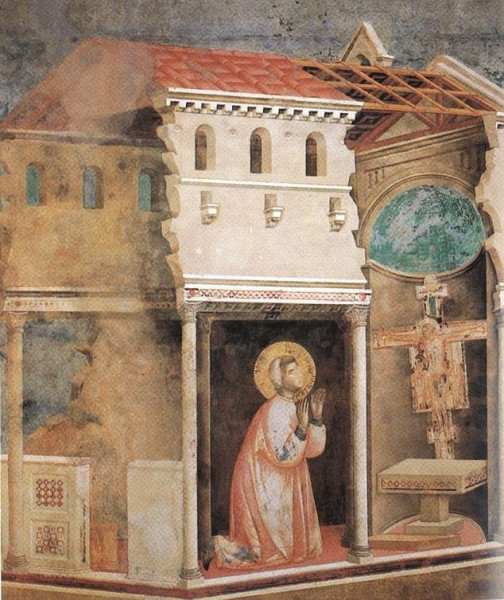
He lived as a hermit until 1208, then more and more people joined him. However, he did not dare to give a rule of life to his companions according to his own ideas, so they all went to the Church of Saint Nicholas, where the Gospel book was displayed on the altar. Francis opened the book at random and found this passage: 'If you wish to be perfect, go, sell what you have and give to the poor!' (Mt 19,12). Then he exclaimed: 'Brothers! This is our life! This is our Rule! Go, therefore, and do what you have heard!' All this happened on 15/04/1209. This day is the birthday of the Franciscan Order.
Within a few years, the number of brothers reached 5,000. Francis went to Rome and sought the approval of Pope Innocent III for their way of life. The Pope felt that God had enlightened Francis and set him on his path.
According to legend, Pope Innocent III had a dream: he saw the Lateran Basilica about to collapse, but an insignificant little friar stood next to the church, and as he himself grew larger, he supported the building with his shoulder. A few days later, Francis appeared with his companions before the Pope. It was then that the realisation came: 'Indeed, this is the friar who supported God's Church and saved it from ruin!'
Francis and his friar brothers settled in the Chapel of Saint Mary of the Angels, or the Porziuncola. Around the chapel, the brothers built their huts from branches. Francis regarded poverty as 'Christ's bride'.
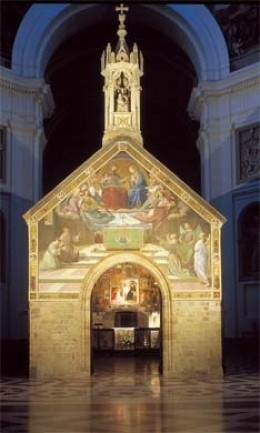
The Porziuncola Chapel (the word portiuncula means 'small portion') stood south of Assisi, in a forest near the town. It may have been built in the 6th century; in the early 13th century, it was owned by the Benedictines of Monte Subasio. Saint Francis restored the dilapidated chapel around 1208, which became a significant place in his life. On 24/02/1209, on the feast of Saint Matthias the Apostle, he heard the Gospel of poverty here (Luke 9,3–5). In 1211, the Benedictines gifted it to him. The 'monastery' built next to it became the ancient mother house of the Franciscan Order. Around the chapel, he held the annual chapter of the order at Pentecost.
The number of members of the order continued to grow. When Clare, the young daughter of a noble Assisian family, also joined Francis's followers, the female branch of the Franciscan community, the Order of the Poor Clares, was born.
Francis's authority was recognised by all, enabling him to mediate peace in a world afflicted by various wars. In 1210 in Assisi, the previously feuding opponents, Bishop Guido and the city leaders, concluded an 'eternal peace treaty' with each other under his influence, and in Arezzo, he prevented a civil war. He also wished to end the Crusades and convert Islam not by sword, but by preaching. After two unsuccessful journeys, in 1219 he managed to reach the Saracens. The Sultan admired this extraordinary man, listened to his sermon, but was unwilling to convert. In 1220, Francis also visited the Holy Land.
One special instance of the saint's many peacemaking efforts is preserved in the legend of the Wolf of Gubbio. Around Gubbio, an exceedingly fierce wolf was causing havoc. It cruelly destroyed both animals and people, tearing them apart, and the entire region lived in fear of it. Despite all warnings, Francis went to the wild beast and spoke to it thus: 'You have caused great troubles, you would deserve to be treated like malefactors, that is, to be executed. You have made the whole city your enemy. But I wish to make peace between you and them.' Then the terrible beast repented, followed Francis, and went with him into the city. There, in the marketplace, in the presence of all the people, peace was solemnly concluded.
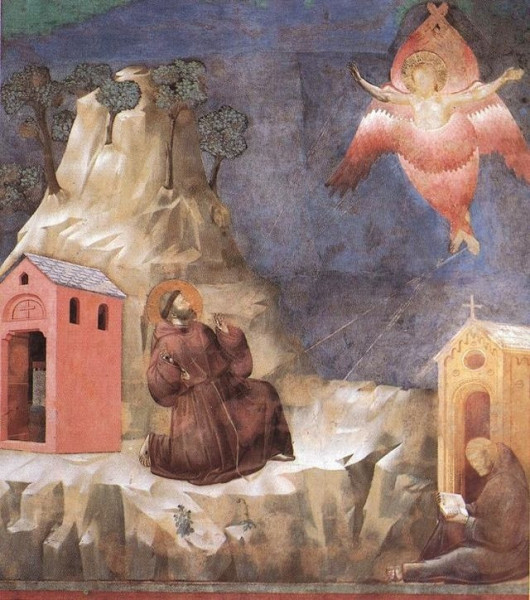
From the moment of his conversion until his death, Francis devotedly followed and proclaimed the crucified Christ. In 1224, on the Feast of the Exaltation of the Holy Cross, he prayed on Mount Alverna, when Christ miraculously renewed the marks of His Passion, the sacred wounds, in the body of His servant.
Saint Francis was not a scholar, yet he so deeply carried the spirit of the Holy Scripture that learned theologians marvelled at his scriptural explanations. A Dominican theologian said of him:
The theology of this man, with its purity and sublimity, resembles the flight of an eagle, compared to which our knowledge crawls on the ground."
In the pure soul of the Saint of Assisi, untroubled joy resided. He taught about the secret of perfect joy in this way, when they were heading towards the Porziuncola one winter morning: 'The good example of the brothers, the power to work miracles, the healing of the sick, and the raising of the dead – these are great things, Brother Leo! But perfect joy is greater than all. It is not found in knowledge, nor in the gift of tongues, nor in great preaching talent, and yet the whole world can be converted with it. And if we now arrive at the Porziuncola, and must wait outside the gate in the rain and cold, because the doorkeeper makes uninvited guests wait, and we bear this with patience – oh, Brother Leo, write this down – in this lies perfect joy! And if upon our further knocking, the doorkeeper rushes out with a club, grabs our habit, throws us to the ground, and beats us thoroughly from head to foot in the snow, if we can bear this too with patience and without complaint, thinking of Christ's suffering – write this down, Brother Leo – in this lies perfect joy!'
In Francis, there lived a deep respect and admiration for God's created world. His poem, the Canticle of the Sun, is not merely a delight in the beauties of nature, but the fruit of Francis's inner spiritual maturation.
Pope John Paul II declared Saint Francis the patron saint of those concerned with ecology in 1979.
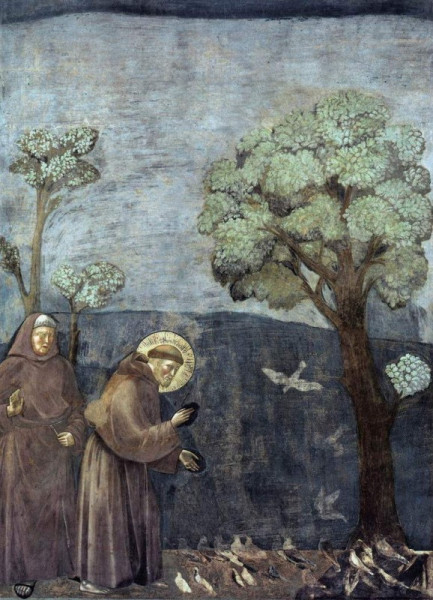
"Saint Francis offers Christians an example of deep and sincere respect for the integrity of creation. As a friend of the poor, who lived in love with all God's creatures, Saint Francis invited all creation – animals, plants, natural forces, and even his Brother Sun and Sister Moon – to praise and glorify the Lord together. The pauper of Assisi testifies that if we live in peace with God, we will be more willing to build peace with all creation, which is inseparable from peace among peoples."
(Pope John Paul II: The Ecological Crisis: A Common Responsibility. Message for the World Day of Peace. 01/01/1990.)
* * *
"Saint Francis was a mystic, a pilgrim who lived simply and in wonderful harmony with God, with others, with nature and with himself. [...] whenever Francis looked at the sun, the moon, or even the smallest animals, he would begin to sing, and he included all creatures in his song of praise. [...] for him, all creatures were brothers and sisters, connected to him in love. Therefore, he felt it his duty to care for all that exists. [...] Saint Francis's poverty and simplicity were not merely external asceticism, but something more radical: a renunciation of turning reality into a mere object of use, over which one could dispose. [...] Saint Francis – faithful to Holy Scripture – proposes that we consider nature as a magnificent book through which God speaks to us, reflecting something of His beauty and goodness to us.' (Pope Francis: Laudato si’)
Before his death, Francis blessed his brothers, had Jesus' farewell discourse read aloud, and once again offered a piece of bread to those present. Afterwards, he asked them to strip him and lay him on the bare ground – he wished for ultimate poverty to be his burial garment. He greeted death with the exclamation 'Welcome, Sister Death!' and, singing, he returned his soul to the Lord on 03/10/1226 in the Porziuncola.
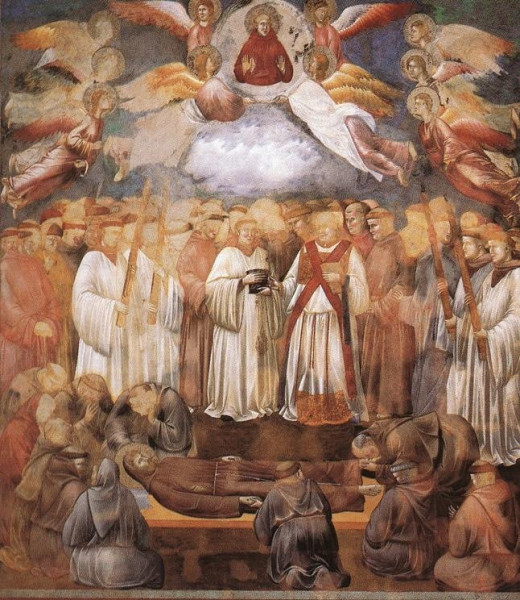
Barely two years later, Pope Gregory IX canonised him. His feast day was immediately entered into the Roman Calendar, with the date of 4 October.
O God, You granted Saint Francis of Assisi to become like Christ in poverty and humility. Make us ready to follow Your Son in his footsteps, and with joyful hearts to be united with You! Through our Lord Jesus Christ, Your Son, who lives and reigns with You in the unity of the Holy Spirit, God, for ever and ever. Amen.
Source: Magyar Kurír
Joyful News Press Office/Diocese of Debrecen-Nyíregyháza