
On Holy Saturday, the Church meditates on Christ's Passion and Death, lingering before the Holy Sepulchre. The evening Vigil service marks the beginning of the Catholic Church's most important feast, Easter, which proclaims the greatest joyful news of Christianity: Jesus Christ rose from the dead and invites everyone to eternal life.
Bishop Ferenc Palánki of Debrecen-Nyíregyháza will celebrate the Easter Vigil service at St. Anne's Cathedral in Debrecen from 20:00. On Easter Sunday, the Feast of the Lord's Resurrection, he will celebrate Holy Mass at 10:30 in the Co-Cathedral of Our Lady of Hungary in Nyíregyháza.
Holy Saturday is a day of mourning; Jesus now lies in the tomb, sealed by a large stone. On Holy Saturday, there is an opportunity for prayer before the Holy Sepulchre throughout the day. On this day, we prepare for the joy of the Resurrection. At this time, silence fills our homes, our families, and our hearts, helping us to delve into the mystery of Christ's love and death. Holy Saturday – Jesus rests in the tomb, and the faithful visit the Holy Sepulchre set up in churches.
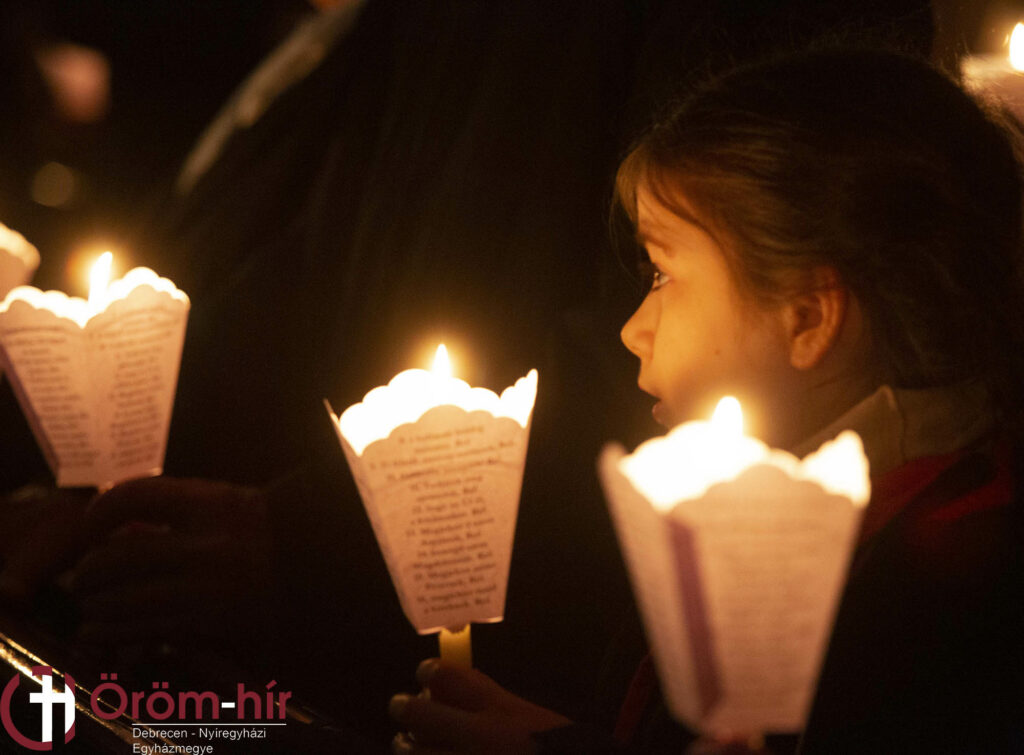
Easter is the greatest feast of Christianity. On Easter night, perhaps the Church's most beautiful celebration reveals the sacred mysteries to us. In the symbols of the liturgy, light and darkness, fire and water, the sun and the stars appear to together exalt the Risen Christ, who conquered darkness and death. The liturgy begins in darkness, in the darkness that enveloped the world after Christ's death. When it seemed that death had conquered life, and sin had conquered Christ. In this darkness, hope ignites: the light of Christ's Resurrection.
The Vigil service consists of four distinct essential parts: the Liturgy of Light, the Liturgy of the Word, the Blessing of Water, and the Liturgy of the Eucharist. The current liturgical order can be traced back to the IV century.
The Easter Vigil service begins with the blessing of fire. Only the glowing coals provide light, and with fire taken from them, the priest lights the Paschal Candle while praying that Jesus Christ, yesterday and today, He is the Beginning and the End, He is the Alpha and the Omega, all time belongs to Him, and all ages, to Him be glory and power through all ages forever. The light of the Paschal Candle itself signifies Jesus Christ, His Resurrection, which shines into the darkness of the church and simultaneously into the darkness of the world, to give new hope.
From this new fire, the Paschal Candle is lit, which symbolises the body of Jesus, with the incense grains within it signifying Jesus' mortal wounds. There was no witness to the Resurrection, for Jesus did not rise into this world, within the confines of this space and time, but passed into eternity; yet the Church's liturgy in a way makes present the moment of the Resurrection; this occurs when the new fire animates the lifeless body of the candle. Symbolically, this is the moment of the Resurrection. The multitude of candles lit from the blessed fire illustrates the spread of Christ's light, showing that in the darkness of sin and death, the power of Christ's Resurrection extends to all humanity. The priest proceeds with the light into the dark church, and in three steps distributes Christ's light to the faithful, who light their own candles from the Paschal Candle. The light of Christ fills the dark church. We hear and see this joy: "The Light of Christ", to which we respond: "Thanks be to God." After this, the Church's most beautiful hymn, the Exultet, the Easter Proclamation, is sung. The Easter Proclamation articulates the content of the feast, the light that symbolises the Resurrection and redemption.
After the Easter Proclamation is sung, the Liturgy of the Word begins, which leads us through the great stages of salvation history, arriving at the New Testament. Then the Gloria, the praise of God, is intoned and "the bells return," calling the faithful to celebrate Christ's victory. Following the Epistle, the solemn Alleluia expresses the exultant joy of God's people. The Gospel proclaims Jesus' Resurrection, the true Good News.
Following ancient tradition in Catholic churches, the Sacrament of Baptism is usually administered during the Easter Vigil on Holy Saturday to those who have converted in adulthood; that is, it is at this time that the Church receives them into its membership. After the homily, the solemn rite of baptism follows. First, the Litany of the Saints, for through baptism one becomes a member of the Church, to which the communion of saints belongs. This is followed by the blessing of the baptismal water and the baptism. The Church blesses water even when no baptism is taking place. The faithful renew their baptismal vows: they renounce Satan and profess their faith in the one God, the Holy Trinity, and in remembrance of their baptism, the Church sprinkles them with the new water. The responses to the vows are primarily made by those to be baptised and, together with them, by the faithful. Not only because today we all celebrate the mystery of our baptism, but also because all of us must take fraternal responsibility for those to be baptised and for one another.
The service continues according to the usual order of Holy Mass. In Holy Communion, we encounter the Risen Saviour. With the Resurrection Procession, the celebration of the faithful extends beyond the church walls, proclaiming the joy of the Resurrection to the world. This beautiful Central European tradition carries the Good News of the Resurrection into the world, blessing the four cardinal directions. They bring the Good News to the whole world: Christ is Risen! He is truly Risen! Alleluia!
Good News Press Office/Diocese of Debrecen-Nyíregyháza