On Good Friday, the Catholic Church commemorates the death and suffering of Christ. On this day, no Holy Mass is celebrated anywhere in the world, as Christ Himself is the sacrifice; the altar, stripped of all adornment, recalls the bare rocks of Golgotha and Christ who gave Himself completely.
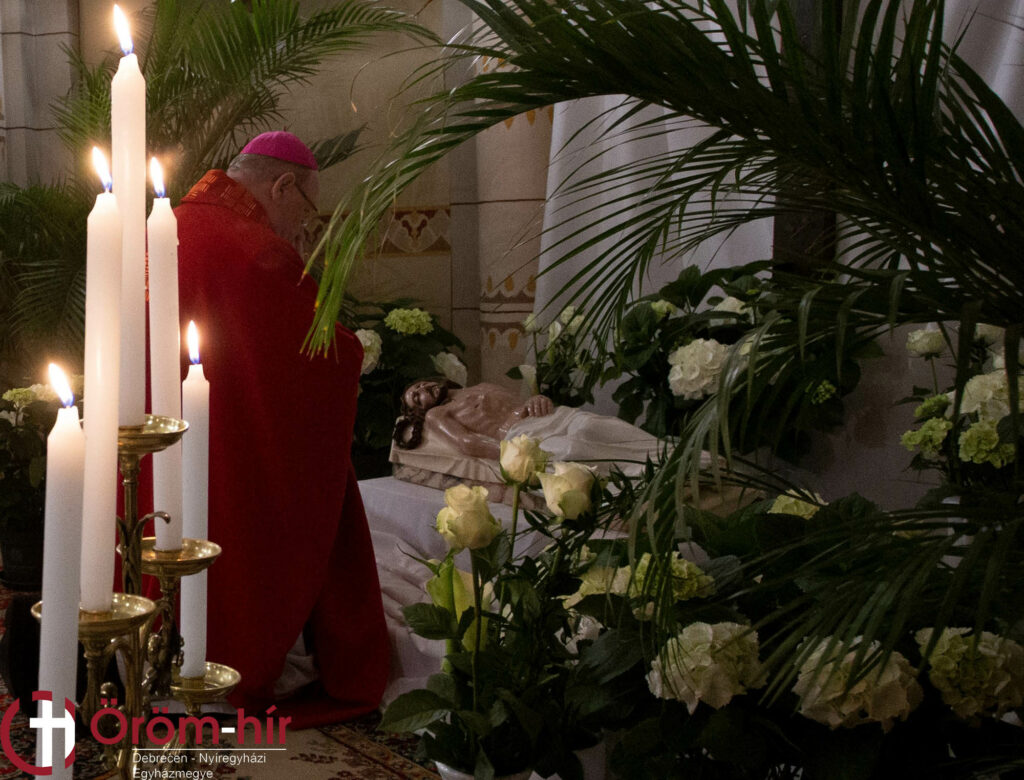
Ferenc Palánki, Diocesan Bishop of Debrecen-Nyíregyháza, will celebrate the Good Friday liturgy from 3 PM in the Our Lady of Hungary Co-cathedral in Nyíregyháza with the priests of the parish. The moving and at the same time uplifting moments of the liturgy make the mystery of Good Friday present and bring it closer to the faithful.
The priest celebrating the liturgy enters the church in silence, vested in red, and prostrates himself before the altar to pray. This moving act is an act of veneration for the sacrifice offered on Golgotha, for Jesus who emptied Himself and humbled Himself to the dust.
On this day, the liturgy consists of three main parts: the Liturgy of the Word with readings and Universal Prayers, the Veneration of the Cross, and Holy Communion. According to tradition, these parts have remained unchanged since the early times.
During the Good Friday liturgy, the readings reveal the mystery of Jesus' suffering. First, the Old Testament reading from the Book of the Prophet Isaiah (Is 52,13–53,12) is proclaimed. The prophet speaks of the fate of the Lord's servant, the suffering of the Just One, whose sacrifice God accepts. The suffering servant, Ebed Yahweh, the Old Testament Mediator of Salvation, is a prefigurement of the Messiah. The second reading is from the Letter to the Hebrews, where Christ appears before us as the true and perfect High Priest (Heb 4,14–16; 5,7–9). The dramatic climax of the Liturgy of the Word follows: the reading (or chanting) of the Passion narrative from the Gospel of John (Jn 18,1 – 19,42). It is then that the deepest mystery is revealed: the High Priest who accepts suffering, a torturous death, is none other than Christ, the Son of God, whose sacrifice the Father accepts for our salvation, for the salvation of all humanity.
After the readings, the Church's Universal Prayers follow. During these prayers, intercession is made for all humanity, for Holy Mother Church, for the Pope and bishops, for the clergy, for secular and ecclesiastical leaders, and for every single person.
After the prayers, the priest removes the veil from the cross, which was covered on Passion Sunday (5th Sunday of Lent), and the faithful venerate the crucifix with a genuflection and a kiss, upon which the tortured, sacrificed body of the Redeemer becomes visible. With the Veneration of the Cross, Holy Mother Church gives thanks for God's infinite love, forgiveness, and for conversion. He is the one who lives today and still suffers for His Church.
Since there is no Holy Mass on this day, after praying the Our Father and the Lamb of God, the faithful receive the previously consecrated Host during Communion. The Good Friday liturgy ends with this, but in almost every church there is an opportunity for common vigil and prayer.
On Good Friday, the Church requests the faithful to observe strict fasting. The faithful between 18 and 60 years of age may eat three times, but only one full meal, and from the age of 14, abstinence from meat is also required. Through this self-denial, the faithful express their love for Jesus. During the day, the Lamentations (Lamentations of Jeremiah) are recited in churches, and the Stations of the Cross are also held in most churches.
Joyful News Press Office/Diocese of Debrecen-Nyíregyháza